
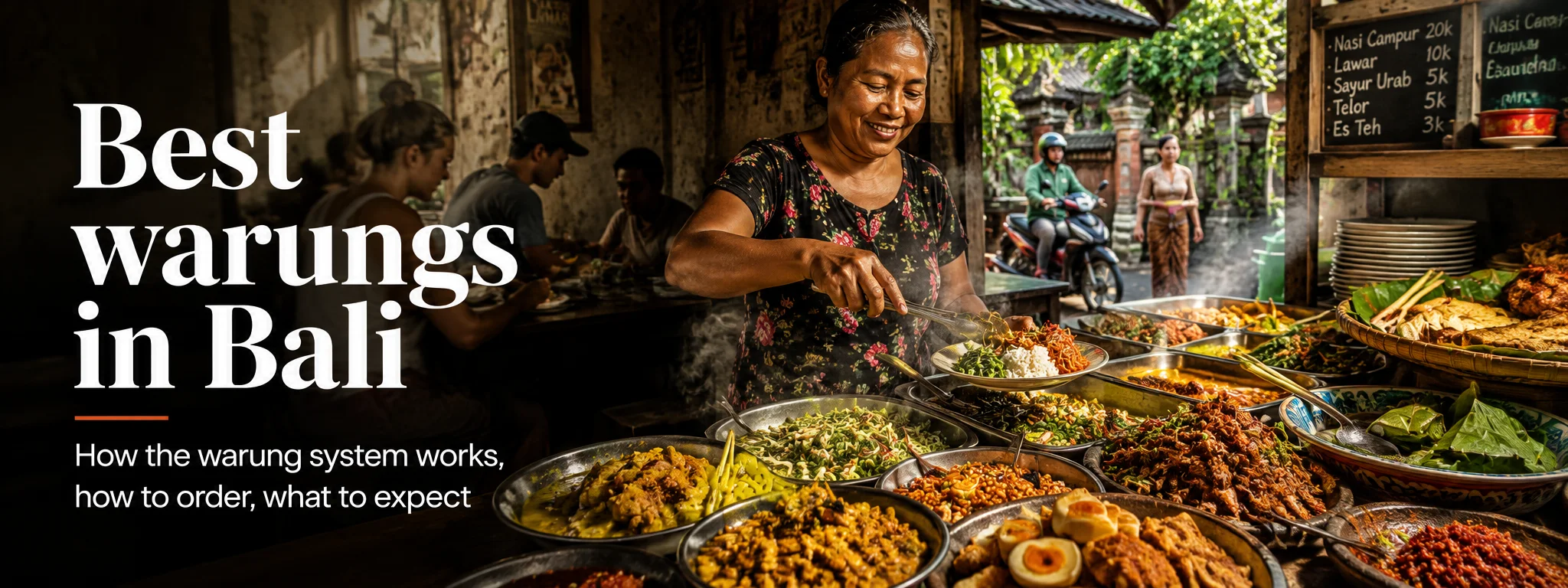
If you want Bali to feel cheaper, tastier and a little less like a resort brochure, eat at warungs. They are not one uniform category — they range from tiny rice counters to famous specialists — but learning how they work is one of the most useful food skills a visitor can pick up.
I do not chase the absolute cheapest plate or pretend every local-looking place is automatically brilliant. I look for turnover, food that is being handled sensibly, dishes I actually want and a counter or menu I can understand without turning lunch into an audit.
01 What a warung actually is
Warung is a wonderfully imprecise Indonesian word. It can describe a tiny roadside stall, a family-run room with six tables, a glass-fronted counter selling rice and side dishes, a specialist that serves one recipe all day, or a business that began as a simple warung and grew into a full restaurant. That range matters: a place does not become “inauthentic” because it has a printed menu, tourists at the tables or an air-conditioner.
I like the word warung precisely because it is loose. It tells you the scale and style more than it tells you exactly what will be on the plate, so walk in expecting variety rather than a standardised “warung menu”.
For travellers, the useful distinction is less about labels and more about how the food is cooked and ordered. The classic everyday format is a rice counter — often described as nasi campur or nasi rames — where several cooked dishes are displayed and you build a plate from them. Other warungs cook dishes to order, while specialist places focus on one thing such as babi guling, nasi ayam, fish soup, bakso or grilled satay.
Bali’s warungs also reflect the island’s mix of Balinese and wider Indonesian food. A Javanese-style nasi campur counter, a Muslim-owned Padang-style place, a Balinese pork specialist and a seafood warung may all sit on the same road. If you want the broader culinary picture first, start with our Balinese cuisine guide.
02 The main warung formats
Display-counter warungs are the easiest introduction. Rice is the base and you point to vegetables, eggs, tofu, tempeh, chicken, fish, curries, fritters and sambal. The final price usually depends on what and how many items you choose, especially the protein.
Made-to-order warungs work more like a small café. Nasi goreng, mie goreng, soups, grilled fish or chicken and simple vegetable dishes may be cooked after you order. Waiting a little longer is normal.
Specialist warungs are often the most interesting. A babi guling place may revolve around roast pork and its accompaniments; a nasi ayam specialist may effectively sell one composed rice plate; a fish warung may have only one or two set meals. Famous examples can cost more and attract plenty of visitors, but that does not make the underlying food less relevant to Bali.
Modern warungs blur the line with restaurants. Some have English menus, table service, Wi-Fi and digital payments while keeping Indonesian home-style food at the centre. Judge the place on what it serves and whether it suits you, not on whether the furniture looks “local enough”.
03 How to order nasi campur
At a display counter, look first and decide whether you want a small or generous plate. Ask for rice — nasi putih for white rice or another available rice if offered — then point to the dishes you want. There is no shame in pointing; it is how many people order even when everyone speaks Indonesian.
A useful sequence is: choose rice, one or two vegetable dishes, tofu or tempeh, then a protein if you want one, and finish with sambal. If you are sensitive to chilli, say “sambal sedikit” (a little sambal) or “tidak pedas” (not spicy). The second phrase is a request, not a scientific guarantee: a dish can already contain chilli in its spice paste.
If prices are not displayed and budget matters, ask “berapa?” (how much?) or ask the price before the plate becomes elaborate. Protein, seafood and specialist items can change the total far more than rice or vegetables. At some warungs you pay immediately; at others you sit down and pay at the end. Follow the flow or simply ask.
04 What to try
Nasi campur Bali is the obvious starting point because one plate can include several textures and flavours: rice, vegetables, tempeh or tofu, chicken or pork, satay, shredded coconut, peanuts and sambal. There is no single universal composition.
Ayam or bebek betutu brings the aromatic side of Balinese cooking — poultry seasoned with a complex spice mixture and cooked until tender. Babi guling is roast pork served with accompaniments that may include lawar, crackling, sausage, vegetables and sambal. It is a Balinese speciality, but obviously unsuitable for anyone avoiding pork.
Sate lilit differs from the familiar cubes-on-a-skewer style: seasoned minced meat or fish is wrapped around a skewer or stalk and grilled. Lawar is a family of finely chopped vegetable-and-coconut mixtures that may contain meat and, in some traditional versions, blood; ask rather than assuming. Tempeh, tofu, corn fritters, long beans, jackfruit and leafy vegetables make it easy to build a varied plate even without meat, though the seasonings may still contain shrimp paste or meat stock.
For dishes and ingredients in more depth, see our sambal and spice guide and vegetarian and vegan Bali guide.
05 How to choose a good warung
A busy place with steady turnover is a useful sign because food is less likely to sit untouched for hours, but “lots of locals” is not a magic quality certificate. Look at the whole operation: are dishes being replenished, is cooked food protected from obvious contamination, are raw and cooked ingredients handled separately, and does the place look organised rather than neglected?
I look for turnover before décor. A humble place serving a steady stream of locals and visitors can be a much better bet than an empty room with a giant laminated tourist menu. That is a clue, not a guarantee, so basic hygiene still matters.
At a display warung, late morning through lunch can be a strong time to visit because more of the day’s dishes are available. Specialist breakfast places, evening warungs and night-market stalls have completely different rhythms, so there is no universal “best hour”. If a tray is nearly empty, ask whether a fresh batch is coming rather than assuming the last portion is automatically the prize.
Online ratings can help confirm that a place still exists, but they are poor substitutes for looking at the food in front of you. Recent reviews are more useful than an old “best warungs in Bali” list — including ours. For a shortlist that we have refreshed for 2026, see warungs by area.
06 Food safety without paranoia
No restaurant category is risk-free, and a polished dining room is not automatically safer than a roadside warung. The sensible principles are boring because they work: food should be cooked thoroughly, hot food should be served hot rather than held lukewarm for long periods, raw and cooked foods should be kept apart, hands and utensils should be clean, and water and raw ingredients should be safe.
Those points align with the World Health Organization’s core food-safety guidance. For travellers, freshly cooked-to-order food can be easier to assess because you can see it go from heat to plate. At a display counter, steady turnover and hot holding are more meaningful than whether the venue looks fashionable.
If you are cautious with raw produce, choose fruit you can wash or peel yourself and be selective with uncooked garnishes. If you have a medical condition that makes foodborne illness more consequential, use a higher safety margin than a healthy traveller might. Our Bali food-safety guide covers this in more detail.
07 Vegetarian, halal, allergies and spice
Bali is not a place where “Indonesian” automatically means halal. Pork is common in Balinese Hindu cooking, while many Javanese, Padang and Muslim-owned warungs are halal. If that matters to you, look for clear halal signage or ask rather than guessing from the menu.
Vegetarian ordering also needs one extra question. A tray of vegetables may have been seasoned with terasi (fermented shrimp paste), fish sauce, stock or meat. “No visible meat” is not the same as vegetarian. For severe allergies, a tiny kitchen with shared utensils may not be the right environment unless staff clearly understand the ingredient and cross-contact issue.
Useful phrases include “tanpa daging” (without meat), “tanpa babi” (without pork), “tanpa telur” (without egg) and “tanpa terasi” (without shrimp paste). Translate a serious allergy clearly on your phone as backup; do not rely on a vague “I can’t eat this” conversation at a busy counter.
08 Price and payment
Warungs are usually good value, but the old idea that every full plate should cost a fixed Rp20,000–40,000 is no longer useful across Bali. A simple vegetable-and-tempeh plate can still be inexpensive, while seafood, pork, multiple proteins, famous specialist warungs and tourist-heavy neighbourhoods can push the bill much higher.
Rather than memorising a “correct” price, check the menu or ask before ordering. Carry cash in sensible denominations. QRIS payments are increasingly common, but many visitors cannot use every Indonesian QR payment method with an overseas account, and card terminals are not something to assume at a simple warung.
For trip-level budgeting rather than one meal, see our Bali budget guide.
09 Etiquette and useful Indonesian
Warungs are casual. You generally do not need a reservation or special clothing, though normal standards of public dress still apply. Some places want you to order at the counter before sitting; others seat you first. Watch what the customers ahead of you do.
Return plates or clear your table only if the venue’s system suggests it. Tipping is not compulsory at basic warungs; if there is no service charge and you want to leave something extra, rounding up or leaving a modest tip is fine. More useful than performing elaborate etiquette is being patient, saying “tolong” (please/help), “terima kasih” (thank you) and asking rather than snapping fingers or calling staff across the room.
If you want a small bit of Bahasa Indonesia for food and everyday travel, our language guide has the phrases that actually help.
10 The bottom line
Warungs are not a single category of “cheap authentic Bali food”. They are a flexible part of Indonesian daily life, from humble rice counters to famous specialist institutions. The best approach is equally flexible: order what looks good, ask when ingredients matter, judge freshness and handling rather than décor, and be willing to try a place that has never appeared on a viral list.
For me, warungs are not a box to tick for “authenticity”. They are simply one of the best ways to eat everyday Indonesian and Balinese food, spend locally and make normal meals part of the trip rather than treating every lunch as an attraction.
Use our current warungs-by-area guide when you want a starting point, then look around once you arrive. The warung you remember most may be the one you found because it was busy, smelled good and happened to be two streets from your hotel.
TATS Man bottom line: Start with a busy rice counter, point at what looks good, ask about anything you need to avoid and build confidence from there. The best warung meal is often the ordinary one you decide to repeat two days later.
Cheers, Carpe Diem & Eat Where the Rice Is Moving! 🍻⏳🍛
your sambal-respecting warung correspondent

About the author
TATS Man
Travel journalist · digital nomad since 2007 · visiting Bali since 1989
TATS Man is the beer-loving cyborg travel journalist behind Totally Bali and TATS (Totally Awesome Travel Sites). He has travelled and worked remotely since 2007 and has been visiting Bali since 1989. His guides combine long-term destination familiarity with current primary-source research — and he does not claim first-hand experience where he does not have it.