
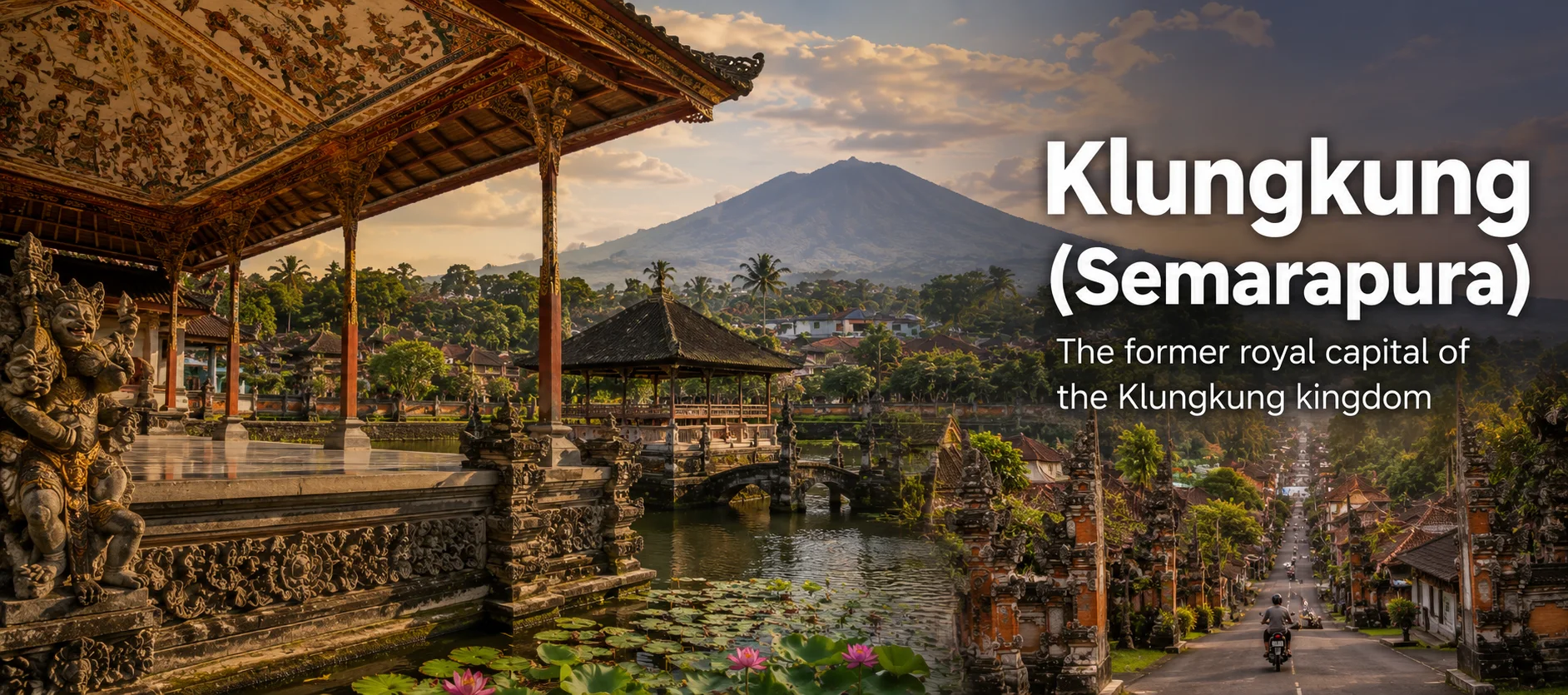
Klungkung is easy to rush past on the road east, but Semarapura rewards a deliberate stop for Kerta Gosa, Kamasan painting, market life and a clearer view of Bali’s royal history.
01 Start with the geography
Klungkung is both a regency and the name travellers often use for its mainland capital area. The administrative centre is Semarapura, a compact town east of Gianyar. That distinction matters because Klungkung Regency also stretches offshore to Nusa Penida, Nusa Lembongan and Nusa Ceningan; a guide to “Klungkung” can otherwise sound as though one small town contains half the attractions of the Nusa islands.
For a mainland visit, think of Semarapura as a cultural stop rather than a resort base. The historic core, traditional market and everyday town life sit close together, while villages such as Kamasan and routes toward Sidemen, Kusamba and Goa Lawah are easier with a car or driver.
The mainland town is also a useful reminder that Bali’s political map and tourism map are different. A traveller can spend a week on Nusa Penida and technically remain in Klungkung Regency without ever visiting Semarapura. This page is specifically about the mainland royal centre and nearby cultural stops.
02 Kerta Gosa is the reason to stop
Kerta Gosa is the surviving historical centrepiece of Semarapura. The open-sided pavilion formed part of the Klungkung royal complex and was associated with meetings and the administration of justice. The adjoining Bale Kambang sits over a pond in Taman Gili, creating the most recognisable view in the complex.
Look up as much as you look around. The ceilings are filled with wayang-style paintings that communicate moral stories, consequences and ideas of justice through images. The detail rewards time; this is not a monument that makes much sense if you walk in, take one photo and leave five minutes later.
There is no need to memorise every painted panel before arriving. A guide or good interpretive material can help explain the stories and why certain punishments or moral consequences appear. If you go independently, slow down enough to notice that different ceiling zones tell different kinds of stories.
03 Kamasan painting: read the ceilings properly
The paintings are closely associated with the classical Kamasan tradition, named for the village south of Semarapura where the style is still practised. Figures, posture, colour and placement follow a visual language shaped by stories from Hindu epics and Balinese narrative traditions rather than the perspective-driven style of modern Western painting.
If the art interests you, add Kamasan village rather than treating the ceiling as anonymous decoration. Workshops and galleries vary, so arrange a visit through a reputable local contact or driver and ask before photographing artists at work. Buying directly from makers can be a more meaningful souvenir than a generic “Balinese” print.
Authentic Kamasan work varies greatly in scale and price. Ask about the artist, materials and whether the piece follows a traditional story. Do not assume an expensive framed work is old, and do not ask a working artist to replicate a sacred or ceremonial image merely because you like the colour.
04 The royal history without the mythology
Klungkung became one of Bali’s most important royal centres after the Gelgel era. The palace complex was largely destroyed during the Dutch conquest in 1908, which is why the surviving gate, pavilions and paintings carry so much historical weight. They are fragments of a larger political centre, not a complete preserved palace.
Avoid compressing that history into a simple “ancient kingdom” story. The surviving site reflects Balinese royal rule, colonial intervention and later conservation. The official Bali tourism office dates the Klungkung royal complex to the late seventeenth century and notes Kerta Gosa’s historic role in discussions of justice, security and prosperity.
05 Semarapura beyond the monument
Central Semarapura is useful precisely because it still functions as a normal regional town. The market is a better place to observe everyday commerce than to chase a checklist of “must-buy” souvenirs. Go earlier for activity, keep bags close in crowded aisles and ask before photographing vendors at close range.
Food is straightforward: local warungs, bakeries and small restaurants are more important here than destination dining. If you are travelling with a severe allergy, carry a translated allergy note and do not assume every stall can manage cross-contact. The point of a stop is atmosphere and context, not culinary theatre.
The town centre can be hot, so build shade and water into the visit. Market surfaces can be uneven and crowded. Travellers with mobility limitations may prefer a driver to reposition between the heritage complex, market and Kamasan rather than assuming everything is a smooth pedestrian circuit.
06 How Klungkung fits an East Bali route
Klungkung works particularly well between South/Ubud and East Bali. A driver can combine Semarapura with Sidemen, Goa Lawah, Kusamba’s coast or a continuation toward Candidasa and Karangasem. Trying to bundle Kerta Gosa, Besakih, Tirta Gangga, Amed and several beaches into one day is the kind of itinerary that produces more windscreen time than Bali.
If you are heading to the Nusa islands, remember that the islands are in Klungkung Regency administratively but are separate travel destinations with boat logistics of their own. Do not use “Klungkung” hotel searches as a substitute for choosing the correct island and harbour.
Goa Lawah and the Kusamba coast can be logical eastern add-ons; Sidemen pulls inland. Choose one direction. A driver who understands the day’s ceremonies and road conditions can save more time than a theoretically shorter route chosen from a map.
07 Should you stay overnight?
Most visitors do not need to sleep in Semarapura. Ubud, Sidemen and Candidasa offer stronger accommodation ecosystems for leisure travellers, while Semarapura makes sense for people with a specific cultural, family or work reason to be in town.
If you do stay, choose for practical access rather than resort features: parking, a quiet room, reliable air-conditioning and proximity to the centre. Travellers who want a slower rural evening will usually enjoy Sidemen more; those continuing along the east coast may prefer Candidasa.
08 Dress, ceremonies and photography
Kerta Gosa is a heritage attraction, while temples and ceremonies elsewhere in the regency are active religious spaces. Dress expectations can therefore differ from one stop to the next. Carry a sarong in the vehicle and follow posted or staff instructions rather than assuming a ticket makes every space open for photography.
Do not step through offerings, climb structures for a better angle or push into a ceremony procession. For a fuller explanation, read our Bali etiquette guide and sarong guide before a temple-heavy East Bali day.
09 A sensible half-day plan
Start at Kerta Gosa while the light and heat are manageable, then walk or drive through the central town and market. Add lunch locally. If Kamasan art is a genuine interest, spend the second half of the visit there rather than racing to another landmark.
Allow more time than the map implies when continuing east. Bali road distances are short but travel times are traffic-sensitive. Build your route around two or three meaningful stops, not the maximum number of pins you can fit into a navigation app.
10 Sources and practical checks
For history and heritage context we checked the Bali Government Tourism Office, the Klungkung Regency government and Klungkung’s E-Museum material on Kerta Gosa and Kamasan-style painting. Opening arrangements, local events and any entrance charges can change, so verify those shortly before visiting rather than relying on an old screenshot or blog post.
Continue planning with East Bali, Sidemen, Karangasem and our Bali history timeline.
Current checks included the Bali Government Tourism Office, Klungkung Regency’s Kerta Gosa information and the Klungkung E-Museum. The official sources differ slightly on some historical dating details, so this guide uses the broad, well-supported chronology rather than pretending one disputed date is certain.