
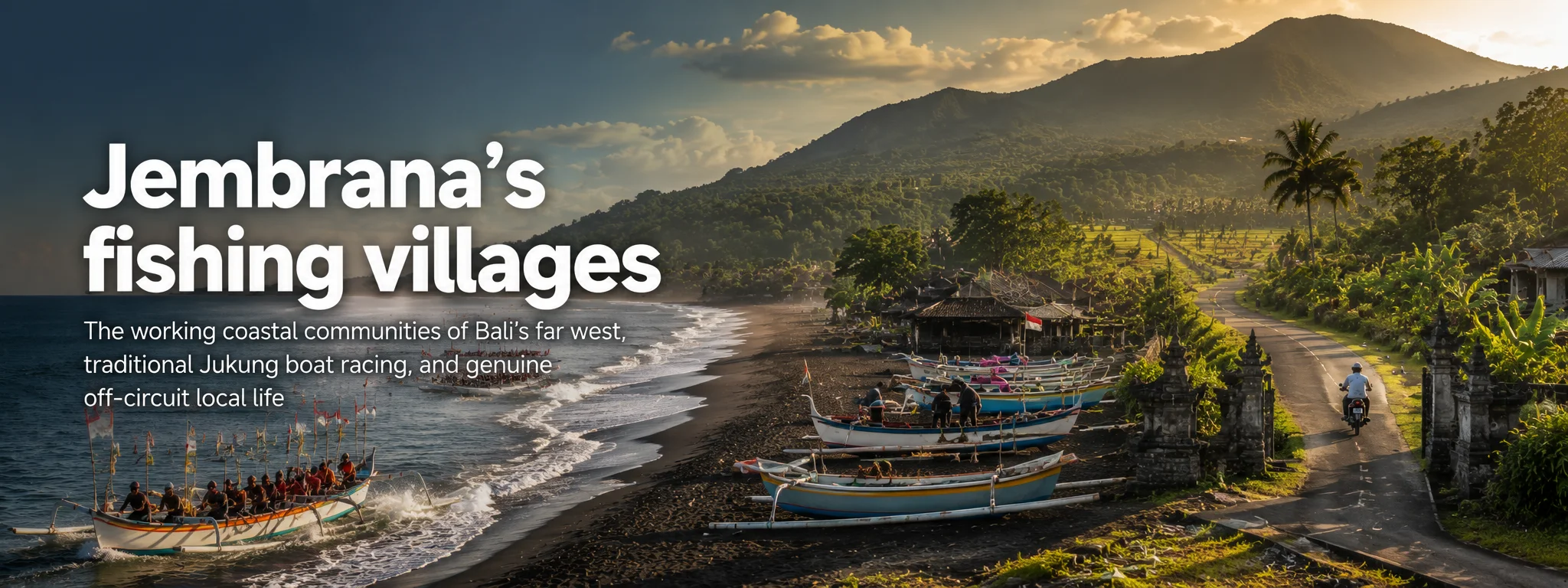
01 Start with the right expectation: this is a working coast
Jembrana’s fishing villages are for travellers who enjoy places because they are real, not because they have been turned into attractions. The coast west and south of Negara has harbours, boat yards, fish processing, mangrove edges and communities whose daily rhythm is tied to the sea.
That means there is no guaranteed “show”. Boats may be out, the harbour may be quiet, rain may change plans and workers may have no interest in posing for visitors. If that uncertainty sounds frustrating, spend your time elsewhere. If it sounds interesting, Jembrana can be one of Bali’s most revealing regions.
02 Pengambengan: the working fishing hub
Pengambengan, in Negara district, is one of the major fishing areas on this stretch of coast. Expect a functional harbour environment rather than a scenic promenade: vessels, loading, unloading, ice, fuel, fish handling and the infrastructure needed to support commercial fishing.
The visual appeal comes from activity and scale, but stay out of work zones. Wet surfaces, vehicles, ropes, equipment and fish-processing areas are not designed for wandering tourists. A local driver or guide who knows the harbour can help you understand where it is appropriate to stand.
Fishing activity also changes with the season and the species being targeted. A harbour that looks intensely busy on one visit can appear almost empty on another. That variability is normal for a working fishery and is exactly why fixed “best time to see the fishermen return” promises are unreliable.
03 Perancak: an easier village-scale introduction
Perancak lies roughly south of Negara and offers a gentler way to experience Jembrana’s coast. Jembrana’s official tourism information describes a community where fishing and farming remain important, with coastal scenery, mangroves and conservation activity among the reasons visitors come.
It is a better choice if you want a short coastal stop rather than the intensity of a working commercial harbour. The village landscape also helps connect fishing with river mouths, mangrove habitat and the broader ecology of West Bali.
Perancak is also a useful place to notice how rivers, mangroves, beach and settlement meet. The landscape is flatter and less dramatic than Bali’s famous cliff coasts, but it tells a clearer story about why communities developed where they did and how livelihoods depend on both land and sea.
04 Jukung, larger fishing boats and what you are actually seeing
Bali’s familiar outrigger jukung are part of the coastal picture, but Jembrana’s fishing economy also uses larger vessels and different gear. Avoid assuming every colourful boat is an old ceremonial object or a tourist prop. Most exist because somebody works from it.
Boat design, paint and decoration can be striking, and asking a local guide about what different vessels are used for is more rewarding than attaching invented folklore to them. Fishing methods and fleets also change over time as economics, regulation and fish stocks change.
05 Mangroves, estuaries and turtle conservation
The Jembrana coast is more than harbours. Mangrove and estuary environments are important nursery habitat and shoreline protection, and Perancak is associated with local turtle-conservation activity. These are good reasons to slow down rather than treat the coast as a sequence of photo stops.
If visiting a conservation project, check how animals are handled and whether the programme prioritises rehabilitation and habitat rather than guaranteed tourist interaction. Avoid touching wildlife for a photo simply because an operator allows it.
06 There is no perfect tourist timetable
Early morning can be useful because fishing communities often become active around landings and markets, while late afternoon gives softer light and a better chance of seeing boats preparing or returning. But sea conditions, season, catch and local schedules matter more than a travel-blog timetable.
Build flexibility into the day. If the harbour is quiet, explore Perancak, Negara or continue toward Medewi and West Bali. The point of coming this far west is to get away from an itinerary where every fifteen minutes must produce an attraction.
07 How to visit without becoming a nuisance
Working harbours deserve the same etiquette you would use in a factory yard or farm. Do not block doors, ramps, loading areas or vehicles. Ask before close-up photography, especially of workers, children and fish processing. A telephoto lens is not a substitute for consent if you are making somebody the obvious subject.
Dress casually and modestly, keep valuables secure around water and crowds, and watch where you step. If somebody is busy, let them work. Buying a drink or meal locally and using local drivers or guides is a more useful contribution than expecting residents to perform hospitality.
08 What to combine with the fishing coast
The coast works well as part of a West Bali road trip rather than a standalone journey from Seminyak. Negara, Medewi, Jembrana’s villages and the road toward Gilimanuk or Pemuteran can be combined depending on where you are sleeping.
If you are based in South Bali, a same-day return creates a lot of driving for a subtle experience. Staying in West Bali gives you the freedom to arrive early, wait out weather and see the region as more than a roadside detour.
Medewi makes a natural eastern or return stop if surfing interests you, while Negara gives you markets, local food and services without a resort-town feel. Travellers continuing west can build the coast into a route toward Gilimanuk, West Bali National Park and Pemuteran rather than backtracking to the south.
09 Weather, sea conditions and practical safety
Harbours are slippery, hot and exposed. Wear shoes with grip, carry water and sun protection, and do not walk onto jetties or vessels without permission. During rough weather, keep well back from surf and harbour edges. Children need close supervision around working water.
If you arrange a boat outing, use an operator providing appropriate lifejackets and basic safety equipment. A local fishing boat being seaworthy for experienced crew is not the same thing as being suitable for an informal visitor excursion.
10 Is Jembrana’s fishing coast worth visiting?
Yes, if you are interested in working Bali, regional livelihoods and places where tourism is secondary. Perancak is approachable, Pengambengan is more industrial, and together they show a side of the island very different from beach clubs and resort strips.
No, if your priority is a guaranteed photogenic attraction with cafés, signage and a fixed programme. Jembrana rewards curiosity and time. The absence of a polished tourist layer is the reason to go, not a problem to be solved.
It is also one of the few Bali experiences where doing less improves the visit. Sit with a coffee, watch the harbour for a while and let the activity explain itself. A rushed ten-minute photo stop usually produces less understanding than an hour with no fixed objective.